🎉 Up to 70% Off Selected ItemsShop Sale

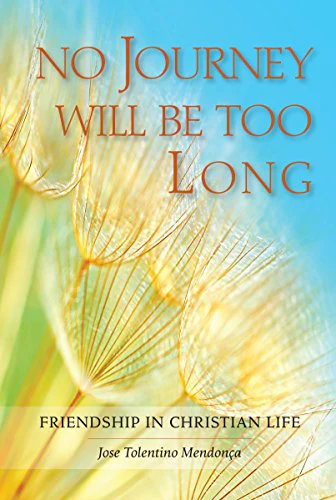
No Journey Will be Too Long: Friendship in Christian Life
In this engaging book, priest, poet, and professor José Tolentino Mendonça helps us to think about the meaning and relevance of friendship in various situations: in our personal lives, in the context of communities and believers, in social relationships. Friendship is a universal experience and represents for each individual an irreplaceable process of humanization and hope. Nevertheless, we also need wisdom, including a spiritual wisdom, which will enable us to live it more fully.
"My hope is that this book will help us to think about the meaning and relevance of friendship in various situations: in our personal lives, in the context of communities and believers, in social relationships. Friendship is a universal experience and represents for each individual an irreplaceable process of humanization and hope. Nevertheless, we also need wisdom, including a spiritual wisdom, which will enable us to live it more fully.
'Our friends are part of our life,' wrote Raïssa Maritain. But there is more to it than that: they widen our lives, helping to make them more luminous and authentic; they offer us lightness and depth; they purify it with the truth, leaven it with humor, and insist that it is made for the future. Friends bear witness to our heart that there is always a journey to be undertaken and that no journey will be too long."
From the preface
"This theme is explored with a rare range of reference, a deep immersion in the Word of God, this word of friendship which never ceases to summon us on the way, but also a rich understanding of the classical roots of our own civilization, a sensitivity to poetry, too often lacking in theology, and the insights that can be welcomed from other cultures. It is a deeply civilised book, to be savored.
Timothy Radcliffe, OP
"My hope is that this book will help us to think about the meaning and relevance of friendship in various situations: in our personal lives, in the context of communities and believers, in social relationships. Friendship is a universal experience and represents for each individual an irreplaceable process of humanization and hope. Nevertheless, we also need wisdom, including a spiritual wisdom, which will enable us to live it more fully.
'Our friends are part of our life,' wrote Raïssa Maritain. But there is more to it than that: they widen our lives, helping to make them more luminous and authentic; they offer us lightness and depth; they purify it with the truth, leaven it with humor, and insist that it is made for the future. Friends bear witness to our heart that there is always a journey to be undertaken and that no journey will be too long."
From the preface
"This theme is explored with a rare range of reference, a deep immersion in the Word of God, this word of friendship which never ceases to summon us on the way, but also a rich understanding of the classical roots of our own civilization, a sensitivity to poetry, too often lacking in theology, and the insights that can be welcomed from other cultures. It is a deeply civilised book, to be savored.
Timothy Radcliffe, OP
$19.67
No Journey Will be Too Long: Friendship in Christian Life—
$19.67
Product Information
Product Information
Shipping & Returns
Shipping & Returns
Description
In this engaging book, priest, poet, and professor José Tolentino Mendonça helps us to think about the meaning and relevance of friendship in various situations: in our personal lives, in the context of communities and believers, in social relationships. Friendship is a universal experience and represents for each individual an irreplaceable process of humanization and hope. Nevertheless, we also need wisdom, including a spiritual wisdom, which will enable us to live it more fully.
"My hope is that this book will help us to think about the meaning and relevance of friendship in various situations: in our personal lives, in the context of communities and believers, in social relationships. Friendship is a universal experience and represents for each individual an irreplaceable process of humanization and hope. Nevertheless, we also need wisdom, including a spiritual wisdom, which will enable us to live it more fully.
'Our friends are part of our life,' wrote Raïssa Maritain. But there is more to it than that: they widen our lives, helping to make them more luminous and authentic; they offer us lightness and depth; they purify it with the truth, leaven it with humor, and insist that it is made for the future. Friends bear witness to our heart that there is always a journey to be undertaken and that no journey will be too long."
From the preface
"This theme is explored with a rare range of reference, a deep immersion in the Word of God, this word of friendship which never ceases to summon us on the way, but also a rich understanding of the classical roots of our own civilization, a sensitivity to poetry, too often lacking in theology, and the insights that can be welcomed from other cultures. It is a deeply civilised book, to be savored.
Timothy Radcliffe, OP
"My hope is that this book will help us to think about the meaning and relevance of friendship in various situations: in our personal lives, in the context of communities and believers, in social relationships. Friendship is a universal experience and represents for each individual an irreplaceable process of humanization and hope. Nevertheless, we also need wisdom, including a spiritual wisdom, which will enable us to live it more fully.
'Our friends are part of our life,' wrote Raïssa Maritain. But there is more to it than that: they widen our lives, helping to make them more luminous and authentic; they offer us lightness and depth; they purify it with the truth, leaven it with humor, and insist that it is made for the future. Friends bear witness to our heart that there is always a journey to be undertaken and that no journey will be too long."
From the preface
"This theme is explored with a rare range of reference, a deep immersion in the Word of God, this word of friendship which never ceases to summon us on the way, but also a rich understanding of the classical roots of our own civilization, a sensitivity to poetry, too often lacking in theology, and the insights that can be welcomed from other cultures. It is a deeply civilised book, to be savored.
Timothy Radcliffe, OP